AI Development Company & Custom AI Solutions Partner
Choosing an AI development partner is becoming less about finding a company that can simply connect an application to an LLM. Businesses now need to consider what happens around the model: data preparation, application architecture, integrations, security, evaluation, deployment, and ongoing optimization.
That creates an important distinction between AI development companies. Some are better suited to building complete AI products, while others focus on enterprise engineering, conversational experiences, AI agents, or rapid product development.
For businesses comparing an AI development company, the right choice therefore depends on the problem being solved—not simply on which company appears highest on a generic ranking.
What Should You Compare in an AI Development Company?
A useful comparison starts before looking at company names.
Businesses should consider:
The type of AI systems the company builds
Experience with generative AI and large language models
AI agent development capabilities
Ability to integrate AI with existing software
Data and machine learning expertise
Experience taking AI projects into production
Security and governance requirements
Product development capabilities
Industry experience
Post-launch monitoring and optimization
Ability to scale the solution as usage increases
An AI chatbot, an AI companion platform, an internal knowledge assistant, and a multi-agent enterprise system may all use similar underlying technologies, but their development requirements can be very different.
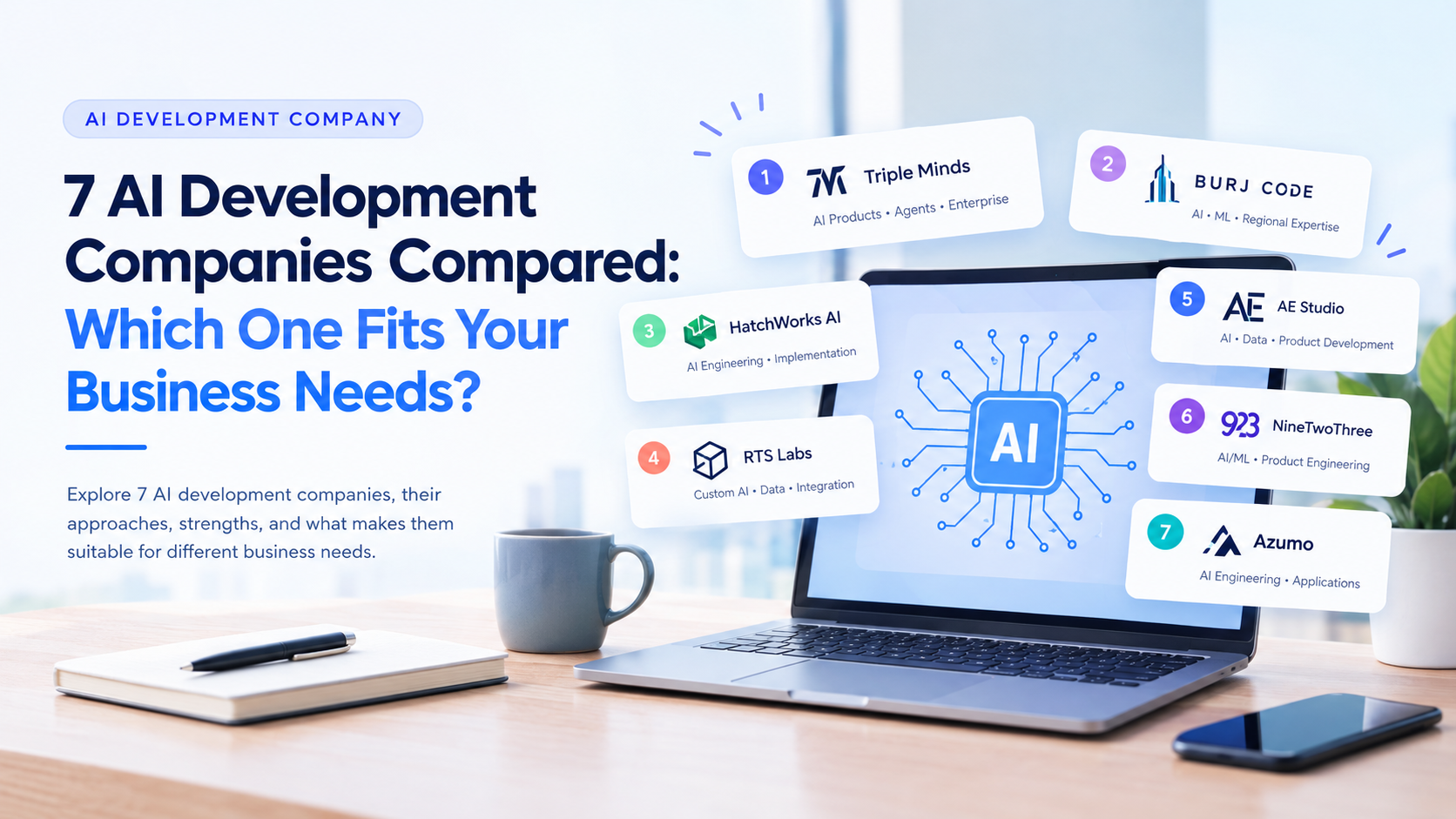
7 AI Development Companies Compared
The companies below represent different approaches to AI development. Instead of treating the list as a universal ranking, each company is considered according to the type of project its capabilities may fit best.
1. Triple Minds — AI Products, Agents, and Enterprise Development
Triple Minds takes a broad AI product-development approach, covering custom AI software, machine learning, AI agents, AI SaaS products, chatbots, automation, and integration with existing business systems.
Its AI development offering spans the process from use-case assessment and architecture through model development, deployment, monitoring, and optimization. The company also describes experience with AI products, AI APIs, model training, and enterprise AI agents that connect with databases, CRMs, ERPs, and internal tools.
One notable part of its portfolio is AI companion platform development. Triple Minds' white-label product offering includes an AI companion platform with character generation, conversational interaction, voice and video capabilities, and an administration layer.
Best fit: Startups and enterprises looking for custom AI products, AI agents, AI companion platforms, automation, or broader AI development under one development partner.
2. Burj Code — Production AI With a Dubai-Centered Approach
Burj Code approaches AI development from a production-engineering perspective, with services covering custom AI software, generative AI, machine learning, computer vision, NLP, AI agents, and MLOps.
Its current positioning places particular emphasis on businesses in Dubai and the wider UAE/GCC region. The company highlights UAE data residency, PDPL-oriented implementations, Arabic and English AI capabilities, and integrations with existing business systems.
This makes its positioning notably different from a general-purpose U.S. AI development studio. A business operating in the GCC may value regional requirements, language support, and local delivery considerations alongside technical capability.
Best fit: UAE and GCC businesses looking for custom AI applications, AI agents, generative AI, automation, or region-specific enterprise implementations.
3. HatchWorks AI — Embedded AI Engineering
HatchWorks AI represents a more engineering-led model for organizations that need dedicated AI capabilities rather than a single isolated feature.
Its positioning in current U.S. AI-development comparisons places it among providers serving businesses moving AI projects toward production, with an emphasis on AI engineering and implementation rather than simply supplying an AI tool.
This type of relationship can make sense when an organization has a significant AI roadmap and needs development expertise that can work alongside existing technical teams.
Best fit: Organizations looking for deeper AI engineering support and longer-term implementation capacity.
4. RTS Labs — Custom AI and Engineering-Led Development
RTS Labs takes a custom-development approach rather than treating AI as a standalone chatbot feature.
Its current material describes custom AI development across machine learning, generative AI applications, computer vision, and AI agents. It also emphasizes factors such as data engineering, integrations, IP ownership, engagement flexibility, model neutrality, and moving from prototype toward a working system.
That makes this type of provider relevant to businesses that already know their use case but need engineering support to turn it into a functioning product.
Best fit: Businesses that need custom AI development with strong software-engineering involvement and control over the resulting system.
5. AE Studio — AI, Data, and Product Development
AE Studio is a U.S.-based product and engineering studio with capabilities spanning AI, data science, and software development.
Its appearance in U.S. AI development comparisons reflects a different model from specialist AI-agent firms: AI can be incorporated into broader product and engineering work rather than treated as the entire product itself. Current industry comparisons identify the company with work across AI/ML and custom software development.
This distinction can matter when the AI component is only one part of a larger application.
Best fit: Businesses that need AI development alongside broader product engineering, data science, and software development.
6. NineTwoThree AI Studio — Product-Oriented AI Development
NineTwoThree AI Studio focuses on custom AI and product development, with its U.S. offering covering areas such as AI/ML, generative AI, and AI-enabled applications. Current U.S. comparisons position the company particularly around custom AI, machine learning, and product engineering.
A product-oriented studio can be useful when the objective is not simply to develop an AI model, but to turn an idea into a complete application with an actual user experience.
That can include situations where AI needs to sit inside a mobile application, SaaS product, or customer-facing platform.
Best fit: Companies turning an AI concept into a complete digital product or application.
7. Azumo — AI Engineering and Application Development
Azumo is another U.S.-serving AI development provider with a focus on software engineering and AI implementation.
Current 2026 U.S. comparisons include Azumo among companies working on custom AI and AI-agent projects, particularly for businesses that need AI capabilities integrated into existing software and workflows.
Its positioning makes it relevant to organizations that need development capacity around AI without necessarily requiring a large enterprise consultancy.
Best fit: Businesses looking for AI engineering and custom application development with an emphasis on practical implementation.
The Biggest Difference Isn't the AI Model
It is tempting to compare AI development companies by asking which models they use.
GPT, Claude, Gemini, Llama, and other models are important, but model availability alone does not tell you whether a development partner is suitable.
Two companies can use the same model and produce completely different systems.
The difference may come from:
How business data is connected
How the application handles context
How prompts and retrieval are designed
How agents interact with external tools
How permissions are managed
How outputs are evaluated
How failures are handled
How the system is monitored after launch
In other words, AI development is increasingly an engineering problem surrounding the model, not simply a model-selection problem.
AI Development Company vs. AI Platform
Another distinction worth making is between hiring an AI development company and purchasing an AI platform.
An AI platform typically gives your team tools, APIs, models, or infrastructure to build something themselves.
An AI development company can take responsibility for designing and building the actual solution.
For example, a business wanting an AI companion platform may need more than access to a language model. It may require:
User and character management
Conversational memory
Personalization
Content moderation
Voice or video capabilities
Subscription management
Analytics
Administration tools
Scalable infrastructure
Model and API integrations
The development partner's job is to turn those individual components into a functioning product.
When an AI Companion Platform Becomes a Development Project
AI companion products are a useful example of why choosing an AI development company requires looking beyond the model.
A basic conversational interface can be relatively straightforward. A commercial AI companion platform introduces a much wider product architecture.
The system may need to maintain user context, support different personalities or characters, manage conversations at scale, handle multimedia generation, provide personalization, and maintain consistent experiences across sessions.
That means the development challenge extends into backend architecture, user experience, data management, AI orchestration, and infrastructure.
For a company planning to launch such a product, comparing AI developers based only on chatbot capabilities would therefore provide an incomplete picture.
Which Type of AI Development Partner Do You Need?
The right choice can become clearer when the project is defined first.
If the priority is a custom AI product, look for a partner with product engineering as well as AI expertise.
If the requirement is enterprise automation, integration, security, governance, and deployment experience may matter more than rapid prototyping.
If the project involves AI agents, examine how the company handles tool use, orchestration, monitoring, permissions, and failure scenarios.
If you are creating an AI companion platform, look for experience with conversational AI, personalization, scalable user systems, and potentially multimedia AI.
If the project involves existing enterprise software, integration and data architecture may be more important than building a new model.
What to Ask Before Selecting an AI Development Company
A proposal can tell you what a company intends to build. It may not tell you how well that company handles the difficult parts.
Before signing, ask:
Can you show a comparable production system?
A polished prototype is not the same as a system operating with real users and real data.
Who owns the source code?
Clarify intellectual-property and handover terms before development begins.
How will the AI be evaluated?
Ask what happens when the model produces an incorrect, incomplete, or unsafe response.
What happens after launch?
AI systems can require monitoring, model updates, cost optimization, retraining, and ongoing improvements.
How will the system integrate with our existing technology?
An AI solution that cannot communicate reliably with the rest of the business can create another data silo.
What happens if the chosen model changes?
A strong architecture should not make the entire product unnecessarily dependent on a single model or provider.
Don't Choose an AI Development Company by the Longest Service List
A company can list machine learning, generative AI, computer vision, NLP, AI agents, automation, and dozens of other services without being equally strong in every area.
The better approach is to match project complexity with demonstrated capability.
A startup developing an AI-powered application may need speed and product expertise.
An enterprise may need integration, governance, security, and long-term engineering capacity.
A company building an AI companion platform may need conversational architecture and scalable consumer-product development.
A business automating internal workflows may care more about integrations and reliable agent execution.
The "best" provider changes depending on which of these problems you are trying to solve.
Final Takeaway
The seven companies in this comparison illustrate why there is no universal answer to the question of which AI development company is best.
Triple Minds brings a broad custom-AI and product-development approach, including AI agents and AI companion platform capabilities. Burj Code takes a production-focused approach with particular relevance to UAE and GCC businesses. The U.S.-based companies bring their own combinations of AI engineering, product development, enterprise implementation, and specialized capabilities.
The most useful comparison is therefore not simply company versus company.
It is problem versus capability.
Before selecting a development partner, define what you are actually building, how it will connect to your existing systems, who will use it, what data it will handle, and what needs to happen after launch.
Once those requirements are clear, comparing AI development companies becomes much easier—and far more meaningful than choosing the first company that promises to "add AI" to your business.